Desert Water Catchment Systems: How We Harvest Rainwater Off-Grid in the Chihuahuan Desert
When people find out we live completely off-grid in the Chihuahuan Desert, the first question is always about water. How do you get it? Where does it come from? What happens when it doesn't rain?
Fair questions. Out here near the Chisos Valley in the greater Big Bend region, water isn't something you take for granted. We get about 12 inches of rain per year. That's it. To put that in perspective, Houston gets over 50 inches. We're working with less water than almost anywhere else in Texas.
But here's what most people don't realize: 12 inches is actually enough. Not just enough to survive, but enough to live comfortably, run a full homestead, and maintain water security year-round. The key is capturing every single drop that falls on your property and storing it efficiently. We also get 25 gallons of potable water each week from our HOA that we pick up ourselves. Whatever we don't use that week gets added to our storage tanks. Because out here, every drop counts.
Our entire water supply comes from passive rainwater catchment off our roofs. No well. No water delivery service. No municipal connection. Just rain, metal roofs, gutters, and storage tanks. After several years of testing, adjusting, and refining our system, we've built something that works reliably even in one of the harshest water environments in the country.

Beginner Guide to Food Preservation
This guide is a simple, approachable introduction to preserving food at home. Whether you’re new to food preservation or returning to it after a break, this resource covers the essentials in a way that’s easy to follow and rooted in practical experience.
It’s written to help you make real progress using tools and ingredients you likely already have in your kitchen no pressure, no perfection required.
What’s Included
A printable PDF guide over 70 pages of full color content
Covers three core preservation methods: freezing, dehydrating, curing, pickling, fermenting, and canning
Step-by-step instructions for each method, including safety tips and basic equipment
Over twenty recipes and whole meal recipes
Designed for US letter-size paper (8.5x11) for easy at-home printing
BONUS: 3 seasonal recipe sheets delivered via email after purchase when you join our mailing list
How to Use
This guide is meant to be used, not just read. Pick one method to start with such as freezing garden produce or making a simple jam and follow the instructions at your own pace.
Why It’s Useful
Preserving food helps reduce waste, save money, and build self-sufficiency. But for many beginners, it can feel overwhelming. This guide breaks it down into manageable steps and encourages you to start small, build confidence, and grow from there.
Delivery
You’ll receive an instant digital download in PDF format, ready to view on any device or print at home.
Start preserving with confidence one jar, bag, or batch at a time.
Download your guide and begin stocking your pantry with real, homemade food.
Disclosure
Some links on FiberMaiden are affiliate links. When you click and purchase, I may earn a small commission at no extra cost to you. I partner only with brands and tools I trust and use in my own kitchen, studio, and garden. Your support means a lot.
The system itself is straightforward. Rain hits our metal roofs, runs into gutters, flows through downspouts, and fills large above-ground storage tanks positioned around our buildings. From there, we use a water pump to pressurize the system for household use and a propane water heater to give us hot water on demand. We're also in the process of tying all our tanks together with a manifold system so we can easily balance water levels across the property without manually transferring between tanks.
It sounds simple because it is. That's the beauty of passive catchment in the desert. No complicated machinery. No high-tech solutions. Just good design, adequate storage, and respect for every gallon that comes your way.
Living on captured rainwater changes how you think about water. You become aware of consumption in ways city folks never experience. You check tank levels regularly. You time showers differently. You fix leaks immediately. But it's not restrictive or uncomfortable. It's just conscious. And honestly, that awareness makes you appreciate what you have in a way that's hard to describe.
The biggest mental shift is understanding desert rainfall patterns. Rain doesn't show up on a schedule out here. We might go two months with nothing, then get two inches in an afternoon thunderstorm. Summer monsoons bring most of our annual rainfall in concentrated bursts. Winter storms add occasional supplemental water. The timing is unpredictable, but the total annual amount is fairly consistent. That's why storage capacity matters more than anything else in your system design.
You also become obsessed with the weather. Back in the city, I almost never paid attention to the forecast except for major events. Out here, hardly a day goes by that I don't check it several times. And even then, the weather is still just a forecast. The actual conditions on our acres might be different by 5 degrees or an inch of rain from what they predicted. Microclimates are real, and when you're living on captured rainwater, those variations matter.
This writeup covers everything we've learned about making passive water catchment work in extreme desert conditions. The roof strategies that maximize collection. The storage approach that gives you security through dry spells. The maintenance that keeps water flowing when storms finally arrive. And the reality of what it takes to build genuine water independence in a place where rain is scarce and every drop counts.
Why Passive Water Catchment Works in Desert Climates
The Big Bend region doesn't do gentle, steady rainfall. We get long dry spells interrupted by fast, powerful storms that dump significant water in a short window. Passive catchment systems are perfect for this kind of weather pattern.
Here's what makes passive systems ideal for desert conditions:
Captures water during intense rainfall events without mechanical systems
Operates independently of power sources (critical when you're running on solar)
Requires minimal maintenance compared to active pumping systems
Scales easily as you add buildings to your property
No moving parts means fewer things that can break
Strategic Roof Design for Maximum Water Collection
Your roof is your primary water collection surface, so every design decision matters. We use metal roofing across all our structures because water sheds quickly and cleanly off the smooth surface. No absorption, no slow draining, no water sitting around evaporating before it reaches your tanks. Metal roofs also have fewer toxic chemicals compared to asphalt shingles or other roofing materials, which matters when you're collecting water you'll eventually drink.
Here's how we've optimized our roofs for catchment:
Pitched angles engineered for rapid runoff
Smooth metal sheeting that minimizes debris accumulation
Unified gutter systems routing water to centralized tank clusters
Direct downspout-to-tank connections that eliminate water loss
Metal roofing outperforms other materials in desert catchment applications. It's durable, heat-resistant, and provides the clean, fast runoff needed to maximize collection during brief rain events.
For water purification, we currently don't have a filter system on the pump or tanks. We purify all our drinking and cooking water with a Berkey inside our home. We do plan on adding purification to the pump at some point, but for now, the Berkey handles what we need for consumption while the rest goes to washing, cleaning, and other household uses.
Above-Ground Storage Tanks: The Backbone of Water Security
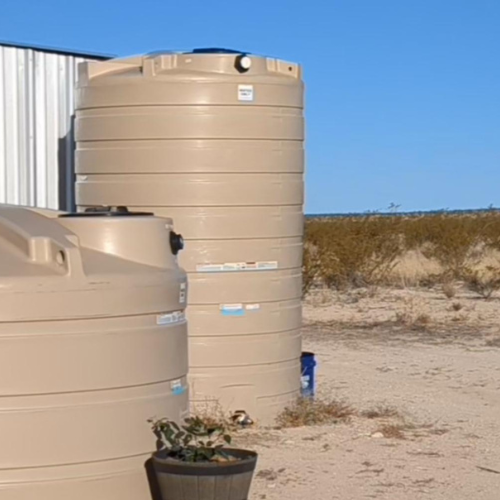
All our collected rainwater flows into large, above-ground, food-grade polyethylene storage tanks positioned strategically near our structures. We've deliberately chosen above-ground installation for several practical reasons that make sense in desert conditions.
Why we went with above-ground tanks:
Significantly lower installation costs (no excavation required)
Easy visual monitoring of water levels at a glance
Simple maintenance and inspection access
Flexible placement that adapts as your homestead grows
No need to dig through rocky desert terrain
One inch of rainfall on 1,000 square feet of roof surface produces over 600 gallons of water. That's the math that drives everything. With our roof square footage and 12 inches of annual rainfall, we can theoretically collect thousands of gallons per year. But theory and reality are different things. You lose water to evaporation, first-flush diversion, and system inefficiencies. That's why we size our storage capacity assuming we'll collect less than the theoretical maximum.
To give you real numbers from our property: we have a 20 by 30 carport with a slant roof, a 14 by 20 house with a barn style roof, a 10 by 8 bathhouse with a slant roof, and a 14 by 14 porch with a slant roof. That gives us about 1,436 square feet of total collection area. With 12 inches of annual rainfall, we can theoretically collect around 10,730 gallons per year. Realistically, after losses, we're looking at 8,000 to 9,000 gallons. Add in the 25 gallons per week we get from our HOA, and we have roughly 9,300 to 10,300 gallons available annually. Our household of two people, one dog, two chickens, and a large garden needs approximately 4,000 to 6,000 gallons per year. The numbers work, but only because we have adequate storage capacity to bridge the months between rain events. You also need to plan for the worst. There could be many dry years with less than average rainfall. Your system needs to handle those lean years, not just the good ones.
Many people out here use gravity-fed systems. We've chosen not to. We use a water pump to pressurize our system for household use. Gravity alone won't give you the pressure needed for comfortable showers or consistent water flow throughout your buildings. The pump pulls from our storage tanks and pressurizes the lines running to all our fixtures. For hot water, we run a propane water heater that gives us on-demand hot water without needing to maintain a large tank of heated water all the time.
One upgrade we're implementing now is tying all our tanks together. Because we have multiple tanks, some might be full while others are low. The tie in will let us balance water across all tanks, so we're using our total storage capacity efficiently instead of having to manually transfer water between tanks with pumps and hoses. It's a simple improvement that makes managing the whole system much easier. The best part is it's non-mechanical. Just a hose and gravity getting the job done.
Maintenance Requirements for Desert Catchment Systems
Even passive systems need regular attention to keep them running right. Desert conditions throw everything at you: dust storms, high winds, extreme temperature swings. All of it impacts your system components.
What we do to keep things working:
Clear gutters of dust and debris after windstorms
Check that all gutter joints stay sealed
Secure tank lids after high wind events
Inspect and clean first-flush screens and debris filters
Look for UV damage on exposed tank surfaces
These tasks don't take much time, but skipping them creates major problems. A clogged gutter during a rare rain event means you just lost water you cannot get back.
Scaling Your Water Infrastructure Over Time
One of the best things about passive catchment systems is how easy they are to expand. Each new building you put up automatically increases your total collection capacity.
Future improvements we're considering:
Additional storage tanks to increase reserve capacity
Centralized filtration system for domestic use
Inline debris filters for better water quality
Overflow systems that direct excess water to native vegetation
Rainwater gardens that use overflow for landscaping
The modular approach means you can start small and expand as needs and resources grow.
Water Efficiency: Making Every Gallon Count
Collection is only half the equation. In a 12-inch rainfall climate, you need to be smart about conservation too.
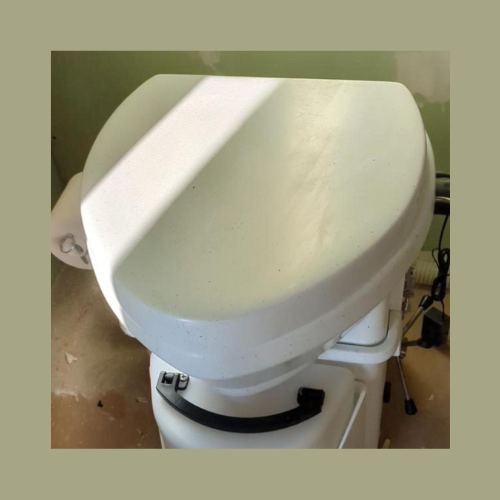
The average American uses 70 gallons of water per day. We average 5 gallons per person. That's not a typo. We've designed every system on this property to either use no water at all or use very little of it. Our toilet, our irrigation system, how we water our animals. Everything is built around minimal water consumption and protection against water loss.
Even the number of animals we keep and what species we choose to buy factors into this. Water consumption drives those decisions.
How we keep usage down:
Low-flow fixtures throughout all buildings
We don't take showers every day
Greywater systems for garden irrigation
Drought-adapted landscaping that needs minimal water
Water-efficient animal watering systems
Strategic timing of water-intensive tasks
Continuous monitoring of consumption patterns
We track water usage carefully. Our annual supply is finite and has to last through extended dry periods. You learn to be conscious about it without being obsessive. When you're living on 5 gallons per person per day, you get very good at making every drop count.

Get 3 Free Recipe Sheets
Ready for recipes that don't require a culinary degree to follow? Get seasonal recipe sheets designed for real kitchens and busy lives, the kind that work even when your kids are asking for snacks mid-prep.
Real-World Performance: What to Expect
After several years running this system, we've got realistic expectations for what water catchment actually looks like in extreme desert conditions.
What we've learned:
A good monsoon season can fill our tanks completely
Winter months may pass with zero rainfall
Summer storms might drop 1 to 2 inches in a single event
Annual collection varies significantly year to year
Proper storage capacity prevents shortages during dry spells
The unpredictability of desert rainfall makes large storage capacity non-negotiable. We size our tanks assuming longer than average dry periods, because eventually you'll hit one.
Cost and Return on Investment
Building a comprehensive water catchment system requires upfront investment. But the alternative, hauling water indefinitely, is neither sustainable nor cost-effective for off-grid properties.
What you're looking at for initial costs:
Food-grade polyethylene storage tanks
Quality guttering and downspout materials
Tank stands or pads for elevation and drainage
First-flush diverters and filtration components
Installation labor if you're not doing it yourself
The payback period depends on your water needs and what it costs to haul water in your area. Most off-grid homesteaders find the system pays for itself within a few years. After that, you're essentially getting free water for the life of the system.
Lessons Learned from Years of Desert Water Harvesting
Living entirely on captured rainwater in the Chihuahuan Desert has taught us things you only learn from actually doing it.
What we've figured out:
Always overestimate your storage needs
Simpler systems are more reliable
Regular maintenance prevents emergency repairs
Water consciousness becomes second nature
Independence from municipal systems is empowering
Our passive water catchment system has made comfortable, sustainable living possible in one of Texas's most challenging environments.
Building Water Resilience in Arid Climates
With thoughtful design, adequate storage capacity, and consistent maintenance, rainwater catchment systems provide reliable water security even in extremely arid regions. Our experience in the greater Big Bend area shows that strategic roof design paired with properly sized above-ground storage creates resilient water infrastructure that works for off-grid desert living.
Every drop matters in the desert. A well-designed passive catchment system turns those drops into the foundation of sustainable homestead life, even in the harshest climates. It's not just about surviving. It's about living comfortably and independently in a place most people think is too dry to support life without outside water sources.
We've proven that wrong. With the right system, 12 inches of annual rainfall is enough.
Desert Rainwater Collection Calculator
Calculate how much water you can collect from your roof